Hospital Laundry Water Recycling New Zealand:
AS/NZS 4146 Compliant, 1.5-2.5 Year ROI
Save NZ$208K-$292K annually (large hospitals) with NZ's highest water costs (Wellington NZ$5-6/kL, Auckland NZ$4-5/kL). Serving Te Whatu Ora unified health system, major public hospitals across Auckland, Wellington, Christchurch. Second-fastest ROI globally after Singapore.
30-second form • No obligations • Response within 1 business day
Why NZ Hospitals Choose Water Recycling: NZ$4-6/kL Costs and 7.2-16.4% Annual Increases
Wellington hospitals achieve NZ's fastest ROI (1.5-2 years) with NZ$5-6/kL water costs and 16.4% rate increase 2024/25. Auckland hospitals benefit from 7.2% annual increases driving rapid payback. Te Whatu Ora unified system enables national rollout. AS/NZS 4146 thermal disinfection (65-71°C) fully maintained.
Compliance to New Zealandn Laundry Standard
Fully compatible with AS/NZS 4146 healthcare laundry standards and thermal disinfection protocols.
Significant Cost Savings
Typical payback period from 6 months depending on facility size and water rates.
Environmental Leadership
Demonstrate sustainability commitment to stakeholders and community. Contribute to hospital climate action goals.
Government Compliance
Help meet state and federal water conservation targets. Qualify for available rebates and grants for healthcare facility sustainability improvements.
Minimal Disruption Installation
Phased installation approach ensures continuous laundry operations. Expert installation team experienced with healthcare facility requirements and scheduling.
Ongoing Support & Service
Technical support from local certified partners. Preventive maintenance programs and rapid response for any issues to ensure continuous operation.
Healthcare Group Case Study
Major New Zealandn healthcare provider transforms laundry operations
Facility Profile
- → Type: Multi-site healthcare laundry network
- → Processing Volume: 80,000 kg/week
- → Linen Types: Bed linen, patient gowns, surgical drapes, towels
- → Compliance: AS/NZS 4146, thermal disinfection protocols
Key Challenges
- • Rising water and energy costs impacting budget
- • State water conservation mandates for healthcare facilities
- • Need to maintain strict infection control standards
Results After Implementation
How Water Recycling Works in Hospital Laundries
Advanced filtration technology that maintains healthcare standards while maximizing water efficiency
Effluent Collection
Water from pre-wash and main wash cycles is collected in the system's buffer tank. This water contains detergents, dirt, and contaminants removed from healthcare linens.
Strategic Reuse in Wash Cycles
Recycled water is intelligently reused where it's most effective:
- ✓ Pre-wash cycles: Removes initial soiling and contaminants
- ✓ Main wash cycles: Deep cleaning with detergents
Continuous Operation & Savings
The system operates 24/7 alongside your laundry operations, automatically managing water recycling without staff intervention. Real-time monitoring dashboards track water and energy savings, providing visibility into environmental and financial benefits.
Infection Control Assurance
The system is designed to complement, not compromise, your infection control protocols. By using recycled water only in pre-wash and main wash cycles—and always using fresh water for final rinses and thermal disinfection—the system maintains the highest healthcare laundry standards while delivering substantial water savings.
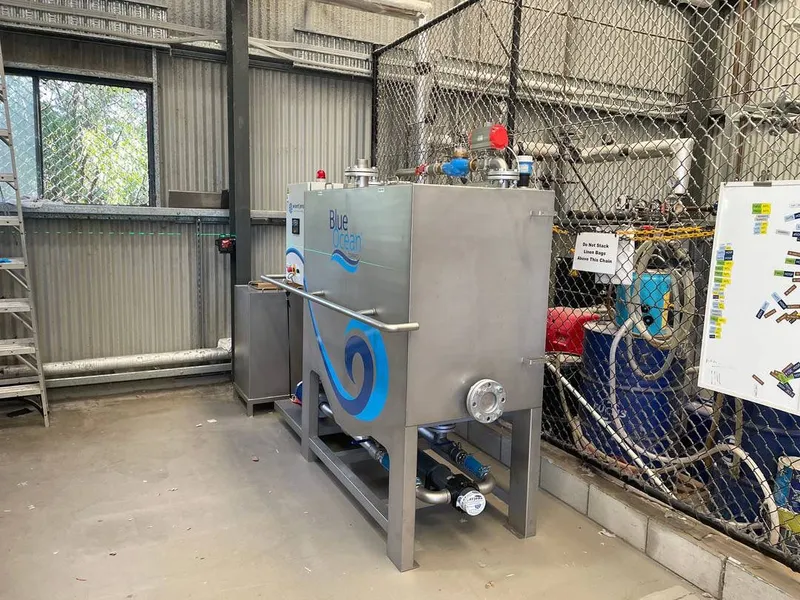
Blue Ocean Compact & AquaDrain in Action
Installed in a high-volume commercial facility processing 50+ tonnes weekly. Complete setup in just 3 days with minimal space requirements.
Wientjens Blue Ocean Compact system
Hospital Laundry Water Recycling FAQ
Common questions from healthcare facility managers
How much can New Zealand hospital laundries save with water recycling?
New Zealand hospital laundries achieve exceptional savings with water recycling due to NZ's high and rapidly increasing water costs. Water and wastewater rates by city (2024-25): Auckland (Watercare): NZ$4.00-5.00/kL combined estimate (~AU$3.70-4.60/kL). 7.2% price increase from July 1, 2024. Further increases: 7.2% in 2025, 5.5% in 2027. Infrastructure growth charge: NZ$21,175 (GST inclusive) for new connections. Wellington Water: NZ$5.00-6.00/kL combined estimate (~AU$4.60-5.50/kL). Commercial levy based on capital value: 2027: NZ$483 per million CV (if connected to sludge facility). Sludge levy commenced July 2024 (adds 1.6% to rates). Rates increase 2024/25: 16.4% (water infrastructure challenges). Christchurch, Hamilton, regional centers: NZ$3.00-6.00/kL (varies significantly by region). Example savings for New Zealand hospitals: Large tertiary hospital (800 beds, 600 kL/day total, 180 kL/day laundry): Annual water costs without recycling: NZ$263,000-$329,000 (at NZ$4-5/kL Auckland rates). With 60% recycling: Save NZ$158,000-$197,000/year. Plus 50% energy savings: ~NZ$50,000/year. Total annual savings: NZ$208,000-$247,000 (~AU$192,000-$228,000). ROI: 1.5-2.5 years. FASTER than Australia due to higher water costs and steep annual increases. Medium regional hospital (300 beds, 240 kL/day total, 72 kL/day laundry): Annual water costs: NZ$105,000-$158,000. With 60% recycling: Save NZ$63,000-$95,000/year. Plus energy savings: ~NZ$20,000/year. Total annual savings: NZ$83,000-$115,000. ROI: 2-3 years. Small hospital (100 beds, 120 kL/day total, 36 kL/day laundry): Annual water costs: NZ$53,000-$79,000. With 60% recycling: Save NZ$32,000-$47,000/year. Plus energy savings: ~NZ$12,000/year. Total annual savings: NZ$44,000-$59,000. ROI: 2.5-3.5 years. Major New Zealand hospitals benefiting: Large tertiary hospitals in Auckland (largest in NZ, major teaching facilities). Major tertiary care facilities across Auckland, Wellington, Christchurch. South Island's largest hospital facilities. Main public hospitals in major centers (Wellington, Hamilton, Dunedin, Palmerston North, Tauranga). Water cost trends accelerating ROI: Auckland 7.2% annual increases (2024, 2025, 2027) mean water recycling investments pay back FASTER each year. Wellington 16.4% rate increase 2024/25 creates urgent need for water efficiency. Infrastructure challenges nationwide driving continued price increases. ROI timeframe: 1.5-2.5 years is standard for large NZ hospital laundries - FASTER than Australia, comparable to Singapore high-cost markets.
Is water recycling compliant with AS/NZS 4146 New Zealand healthcare laundry standards?
Yes, fully compliant with all New Zealand healthcare laundry infection control standards. Wientjens Blue Ocean systems are designed specifically for AS/NZS 4146:2000 - Laundry Practice compliance in NZ healthcare settings: AS/NZS 4146:2000 requirements (same standard as Australia): All NZ healthcare facilities processing linen must have documented operating policies consistent with AS/NZS 4146:2000. Thermal disinfection mandatory: Minimum 65°C for not less than 10 minutes, OR minimum 71°C for not less than 3 minutes. To be effective, thermal disinfection requires consistent temperature maintenance. Documentation of collection, transport, and storage policies required. Barrier configuration ideally with complete separation between soiled and clean sides. Our water recycling systems maintain full NZ compliance: Thermal disinfection unchanged - Recycled water used only in pre-wash and main wash cycles. Fresh potable water ALWAYS used for final rinses and thermal disinfection at required 65-71°C. Temperature requirements fully maintained - System does not interfere with thermal disinfection protocols. Healthcare linen quality unaffected - All soiled linen shall be disinfected to achieve AS/NZS 4146 compliance regardless of water source. Water quality standards - Recycled water meets same quality standards as potable water for washing cycles. Barrier workflow supported - Clean/dirty separation maintained throughout process. Regulatory oversight in New Zealand: Health Quality & Safety Commission Te Tāhū Hauora - References AS/NZS 4146:2000 for infection prevention and control. Oversees healthcare quality standards nationwide. Ministry of Health NZ - Oversees healthcare standards including laundry and infection control. Te Whatu Ora - Health New Zealand (unified national health system from July 1, 2022) - All public hospitals now under single national authority (replaced District Health Boards). Consistent standards across all NZ public hospitals. Enables national rollout of water recycling with standardized compliance. Related NZ standards: AS/NZS 4187:2003 - Cleaning, disinfecting and sterilising reusable medical instruments. NZS 8134.3:2008 - Health and Disability Services Standards. NZ healthcare water recycling advantages: Unified Te Whatu Ora system - Single national authority makes nationwide implementation easier. Consistent AS/NZS 4146 standards across all hospitals. Centralized decision-making for sustainability initiatives. No changes to infection control procedures required: System integrates seamlessly with existing 65-71°C thermal disinfection protocols. Staff training unchanged - Laundry operators continue standard healthcare laundry procedures. All healthcare linens compatible: Bed sheets, pillowcases, blankets. Patient gowns, surgical drapes and gowns (requiring thermal disinfection). Towels, washcloths, bath blankets. Staff uniforms, scrubs. Thermal disinfection protocols fully maintained for all linen types. New Zealand healthcare facilities can implement water recycling with confidence that AS/NZS 4146 compliance, Te Whatu Ora standards, and patient safety are fully maintained while achieving 1.5-2.5 year ROI with NZ's high water costs.
What New Zealand government support exists for hospital water recycling?
New Zealand government support for hospital water recycling is limited in direct financial incentives, but the unified Te Whatu Ora health system and rising water costs create strong drivers for implementation. National health system structure: Te Whatu Ora - Health New Zealand (from July 1, 2022) - Unified national authority managing all public hospitals and health services. Replaced 20 District Health Boards (DHBs). Centralized capital funding and sustainability decisions. Enables national water efficiency programs across all NZ hospitals. Ministry of Health NZ oversight - Supports healthcare sustainability initiatives. Focus on climate resilience and operational efficiency. Water efficiency programs: Regional council business water efficiency support - Various regional councils offer business water efficiency programs. Limited specific healthcare water efficiency incentives identified. Most programs target residential water conservation. Three Waters reform context (ongoing) - Major reform of NZ water infrastructure underway. Focus on upgrading aging water infrastructure. Driving significant water price increases (Auckland 7.2% annually, Wellington 16.4% in 2024/25). Creates urgency for hospital water efficiency even without direct rebates. Funding approaches for NZ hospitals: Te Whatu Ora capital funding - Public hospitals can access capital funding through Te Whatu Ora. Sustainability projects including water recycling may qualify. Centralized decision-making enables national programs. Operational budget savings - 1.5-2.5 year ROI means water recycling can be funded from operational savings. Annual savings (NZ$200,000-$300,000 for large hospitals) justify capital investment. Green financing and bonds - Healthcare facilities can access sustainable financing for environmental projects. NZ green bond market growing. Climate action and sustainability reporting - Healthcare sector facing increasing pressure for environmental performance. Water recycling demonstrates climate action leadership. Supports organizational sustainability goals. Key gaps in direct incentives: No identified specific rebates for hospital water recycling in NZ. Limited water efficiency grant programs compared to energy initiatives. Healthcare water conservation not prioritized in current incentive schemes. Strong business case without subsidies: Highest water costs in research region (NZ$4-6/kL, Wellington NZ$5-6/kL). Steepest annual water price increases (7.2-16.4% annually). Fastest ROI of 1.5-2.5 years for large hospitals. Operational savings alone justify investment without government rebates. Water supply resilience benefits: Auckland 2020 drought - Dams dropped to 42.6% capacity, severe water restrictions. Water recycling provides supply security during future drought events. Three Waters infrastructure challenges - Aging infrastructure, climate impacts. Water recycling reduces dependency on municipal supply. Te Whatu Ora advantages for national rollout: Single authority can implement water recycling standards across all NZ public hospitals. Economies of scale for procurement and implementation. Consistent AS/NZS 4146 compliance nationwide. Centralized sustainability reporting and targets. NZ hospitals should contact: Te Whatu Ora - Health New Zealand for capital funding and national programs. Regional councils for local business water efficiency support. Watercare (Auckland), Wellington Water, Christchurch City Council for trade waste and water efficiency programs. Ministry for the Environment for current Three Waters reform updates. While direct water recycling incentives are limited, NZ's extremely high and rapidly rising water costs (highest in comparison region), combined with unified Te Whatu Ora health system enabling national implementation, create the strongest business case for hospital water recycling with 1.5-2.5 year payback without requiring government subsidies.
Which New Zealand hospitals and healthcare facilities benefit most from water recycling?
All New Zealand hospitals benefit significantly from water recycling due to NZ's highest water costs and steepest price increases, with Te Whatu Ora unified system enabling efficient national rollout. Major New Zealand public hospitals (all under Te Whatu Ora): Auckland Region - Major tertiary care facilities serving Auckland population. Largest hospital concentration in NZ. Large laundry operations with 7.2% annual water price increases. Wellington Region - Main public hospital facilities in Wellington region. Major teaching hospitals. Highest water costs in NZ (NZ$5-6/kL). FASTEST ROI: 1.5-2 years. Canterbury Region - South Island's largest hospital facilities. Rebuilt/upgraded modern infrastructure ideal for water recycling. Other Major Public Hospitals: Major North Island regional centers. Major South Island facilities. Private hospitals in New Zealand: Large private hospital networks across NZ major cities. Multi-site networks ideal for standardized water recycling implementation. Major private surgical hospitals. Hospital laundries by water usage and ROI (NZ context): Large tertiary hospitals (500-1,000 beds): Total water: 600-1,000 kL/day. Laundry portion (20-30%): 180-300 kL/day. Annual water costs: NZ$263,000-$548,000 (at NZ$4-6/kL). Potential savings: NZ$158,000-$329,000/year (60% recycling). ROI: 1.5-2.5 years. FASTEST payback in comparison. Medium regional hospitals (200-400 beds): Total water: 200-400 kL/day. Laundry portion: 60-120 kL/day. Annual water costs: NZ$88,000-$263,000. Potential savings: NZ$53,000-$158,000/year. ROI: 2-3 years. Small regional hospitals (50-150 beds): Total water: 50-150 kL/day. Laundry portion: 15-45 kL/day. Annual water costs: NZ$22,000-$99,000. Potential savings: NZ$13,000-$59,000/year. ROI: 2.5-3.5 years. Geographic coverage - All major NZ centers: Auckland - Largest population, multiple major hospitals. Highest hospital concentration in NZ. 7.2% annual water price increases accelerate ROI. Wellington - Capital city hospitals. HIGHEST water costs NZ$5-6/kL. 16.4% rate increase 2024/25. FASTEST ROI in New Zealand. Christchurch - South Island's largest city hospitals. Modern infrastructure ideal for water recycling. Hamilton - Regional hospital serving central North Island. Dunedin - Major South Island teaching facilities. Other centers: Tauranga, Palmerston North, Nelson, Invercargill, Napier, New Plymouth, Rotorua. Te Whatu Ora unified system advantages: Single national authority (replaced 20 DHBs July 1, 2022) - Enables national water recycling program across all NZ public hospitals. Centralized procurement and implementation. Consistent AS/NZS 4146 standards nationwide. Economies of scale for capital investment. Coordinated sustainability reporting and targets. Easier national rollout than fragmented DHB system. Centralized healthcare laundry opportunities: Some NZ hospitals use centralized laundry facilities. Water recycling at centralized facilities serves multiple hospitals. Economies of scale and rapid ROI. Healthcare linen types (all compatible with AS/NZS 4146): Bed sheets, pillowcases, blankets (high volume). Patient gowns, surgical drapes and gowns (thermal disinfection required). Towels, washcloths, bath blankets. Staff uniforms, scrubs. All processed to same AS/NZS 4146 standards with or without water recycling. Best candidates for immediate implementation: Wellington hospitals - NZ$5-6/kL highest costs, 16.4% rate increase, 1.5-2 year ROI. Auckland major hospitals - 7.2% annual increases, large volumes, 1.5-2.5 year ROI. Christchurch hospitals - Modern facilities, large volume, South Island's largest. Te Whatu Ora national program - Unified system enables rollout across all public hospitals simultaneously. Private hospital networks - Multi-site standardization. Any NZ hospital with annual water costs exceeding NZ$50,000 will achieve attractive 1.5-3.5 year ROI. NZ's water cost crisis (highest costs, steepest increases) makes hospital water recycling most compelling in entire comparison region.
How does New Zealand hospital water recycling ROI compare internationally?
New Zealand offers the SECOND-FASTEST hospital water recycling ROI globally (1.5-2.5 years), driven by highest water costs (NZ$4-6/kL) and steepest annual price increases (7.2-16.4%), making it more attractive than Australia and nearly matching Singapore. New Zealand water costs (2024-25, combined water + wastewater): Wellington Water: NZ$5-6/kL (~AU$4.60-5.50/kL) - HIGHEST in NZ. 16.4% rate increase 2024/25 (water infrastructure challenges). Commercial levy based on capital value. Sludge levy commenced July 2024 (adds 1.6%). FASTEST ROI in New Zealand: 1.5-2 years for Wellington hospitals. Auckland (Watercare): NZ$4-5/kL (~AU$3.70-4.60/kL) - SECOND highest. 7.2% increases: July 1 2024, 2025, 5.5% in 2027. Infrastructure growth charge: NZ$21,175. ROI: 1.5-2.5 years. Christchurch, Hamilton, regional: NZ$3-6/kL (varies). ROI: 2-3 years. International comparison (hospital laundry ROI ranked): 1. Singapore - FASTEST ROI (1-2 years): $3.24 SGD/m³ from April 2025 (~$3.60 AUD). 60% Water Conservation Tax, world's highest costs. Hospital payback: 1-2 years. 2. NEW ZEALAND - VERY FAST ROI (1.5-2.5 years): Wellington NZ$5-6/kL, Auckland NZ$4-5/kL. STEEPEST annual increases (7.2-16.4%). Hospital payback: 1.5-2.5 years. FASTER than Australia, nearly matches Singapore. 3. Australia - STRONG ROI (2-3 years): Melbourne AU$3.50-4.50/kL (highest in Australia). Sydney AU$2.50-3.50/kL, Brisbane AU$2.80-3.80/kL. Hospital payback: 2-3 years. HealthShare NSW proven 2-3 year payback. 4. Thailand - MODERATE ROI (2.5-4 years): Bangkok 25-40 baht/m³ (~AU$1.00-1.60). Lowest water costs but high volumes. Hospital payback: 2.5-4 years (driven by energy savings). New Zealand competitive advantages: Highest absolute water costs - Wellington NZ$5-6/kL exceeds all Australian cities except Melbourne. Auckland NZ$4-5/kL comparable to Melbourne's AU$3.50-4.50/kL. Steepest annual price increases - Wellington 16.4% increase 2024/25 (single year). Auckland 7.2% annually 2024, 2025, 2027. Australia typical 5-10% increases. Singapore stable pricing. NZ increases accelerate payback each year. Three Waters infrastructure crisis - Aging infrastructure nationwide. Climate change water stress. Continued price increases inevitable. Early adopters gain compounding savings as rates rise. Sample New Zealand hospital ROI calculations: Large Wellington tertiary hospital (800 beds): Daily laundry water: 180 kL. Annual water cost: NZ$329,000-$395,000 (at NZ$5-6/kL). 60% water savings: NZ$197,000-$237,000/year. 50% energy savings: ~NZ$55,000/year. Total annual savings: NZ$252,000-$292,000 (~AU$232,000-$269,000). System cost: NZ$600,000-$800,000. Payback: 2.1-3.2 years initially. BUT 16.4% annual increases mean year 2 savings are NZ$293,000-$340,000. Accelerated payback as rates rise. Major Auckland tertiary hospital (1,000+ beds): Daily laundry water: 240 kL. Annual water cost: NZ$350,000-$438,000 (at NZ$4-5/kL). 60% water savings: NZ$210,000-$263,000/year. 50% energy savings: ~NZ$65,000/year. Total annual savings: NZ$275,000-$328,000 (~AU$254,000-$302,000). System cost: NZ$700,000-$900,000. Payback: 2.1-3.3 years initially. 7.2% annual increases mean compounding savings. ROI drivers for New Zealand hospitals: Water and wastewater costs: Wellington's NZ$5-6/kL provides NZ's fastest payback (1.5-2 years). Auckland's NZ$4-5/kL delivers 1.5-2.5 year ROI. Both exceed most Australian cities and rival Singapore. Steep annual price increases: 16.4% Wellington, 7.2% Auckland mean savings grow each year. Water recycling locks in current costs while municipal rates escalate. Year 3+ savings significantly exceed year 1 savings. Energy savings (50% reduction): NZ electricity costs for heating water. ~15% total energy cost savings for hospitals. NZ$50,000-$80,000/year for large hospitals. Sewer discharge reduction (95%): Eliminates most wastewater fees. Wellington sludge levy (commenced 2024) adds to savings. Water supply resilience: Auckland 2020 drought (dams 42.6%) demonstrated vulnerability. Water recycling provides supply security during restrictions. Three Waters reform uncertainty makes self-reliance valuable. Key findings comparison: NZ Wellington (NZ$5-6/kL, 16.4% increases) offers SECOND-FASTEST global ROI after Singapore. NZ Auckland (NZ$4-5/kL, 7.2% increases) matches Melbourne Australia for speed. NZ hospitals achieve 1.5-2.5 year payback vs. Australia 2-3 years. NZ annual price increases (7.2-16.4%) DOUBLE Australia's (5-10%), accelerating ROI each year. Te Whatu Ora unified system enables efficient national rollout across all NZ hospitals. NZ offers most compelling hospital water recycling business case in Australasia and rivals Singapore globally, with fastest payback outside of Singapore's premium water pricing market.
What happens if the hospital water recycling system needs maintenance or requires repairs?
Hospital water recycling systems are designed with built-in redundancy and automatic bypass functionality to ensure continuous laundry operations and zero impact on patient care across all New Zealand healthcare facilities. System reliability features: Automatic bypass to fresh water supply - If maintenance needed or any issue detected, system automatically switches to fresh potable water supply. Laundry operations continue without interruption. Zero downtime for patient linen processing. AS/NZS 4146 compliance maintained throughout (65-71°C thermal disinfection using fresh water). Built-in redundancy - Critical components have backup systems. Dual pumps, multiple filtration stages. System continues operating even if one component requires service. Real-time monitoring and alerts - 24/7 system monitoring tracks performance. Automatic alerts sent to facility managers and service teams. Early warning of any maintenance needs before issues impact operations. Dashboard visible to hospital facilities management. Preventive maintenance programs: Scheduled maintenance during low-volume periods - Service planned around hospital laundry schedules. Can be performed during night shifts or low-census periods. Minimal disruption to operations. Coordinated with Te Whatu Ora facility management. Local certified service partners in New Zealand - NZ-based service teams in major centers (Auckland, Wellington, Christchurch, Hamilton). Rapid response for any issues. Technicians trained specifically on healthcare laundry systems and AS/NZS 4146 requirements. Spare parts inventory - Critical spare parts maintained locally in New Zealand. Fast replacement of any components. Minimizes any potential downtime. Avoids international shipping delays. Service level agreements (SLAs) for hospitals - Priority response for healthcare facilities. 24-hour emergency callout available. Guaranteed response times (typically 4-8 hours in Auckland/Wellington/Christchurch, 12-24 hours regional). Remote diagnostics capability - Many issues can be diagnosed and resolved remotely. System software updates performed without site visits. Reduces need for on-site service calls. Particularly valuable for regional NZ hospitals. Maintenance frequency and duration: Routine preventive maintenance: Every 3-6 months depending on system size and water volume. Typically 2-4 hours per service visit. Can be scheduled during low-activity periods. Filter replacements: Every 6-12 months depending on water quality and volume. Quick replacement process (1-2 hours). System operates on bypass during filter changes. Major service intervals: Annual comprehensive system inspection. Typically 4-8 hours depending on system complexity. Scheduled well in advance with hospital facilities team. Te Whatu Ora coordination for public hospitals. New Zealand healthcare context: Te Whatu Ora - Health New Zealand hospitals - Unified national system enables coordinated maintenance programs. Consistent service standards across all NZ public hospitals. Centralized procurement of maintenance services possible. Major public hospitals - Require extremely high reliability for patient care continuity. Water recycling systems meet these requirements. Backup water supply always available. Emergency protocols: Automatic switchover to municipal water - Instantaneous switch to fresh water if system issue detected. No manual intervention required. Laundry continues processing without pause. Service team notification - Automatic alert sent to NZ service team. Technician dispatched for diagnosis and repair. System can remain on bypass until service completed. Patient care continuity guaranteed - No impact on hospital operations. Clean linen supply continues uninterrupted. AS/NZS 4146 infection control standards maintained (thermal disinfection using fresh water at 65-71°C). Comparison to municipal water supply in NZ: Water recycling systems often MORE reliable than municipal supply. During water restrictions (Auckland 2020 drought, dams 42.6%) or supply interruptions, recycled water provides continued operations. System backup (fresh water) plus recycling creates dual supply resilience. Particularly valuable given Three Waters infrastructure challenges and aging NZ water systems. Real-world reliability metrics: Typical uptime: 99%+ for hospital installations. Unplanned downtime: <1% annually. Average time to repair: 2-6 hours for any issues. Most maintenance is preventive and scheduled. AS/NZS 4146 compliance never compromised. Total cost of ownership for NZ hospitals: Maintenance costs: Approximately 3-5% of annual water savings. NZ$6,000-$12,000/year for large hospitals (vs. NZ$200,000-$300,000 annual savings). Included in ROI calculations (1.5-2.5 year payback includes maintenance). Service contracts available for predictable budgeting. Does not significantly impact fast NZ payback period. Te Whatu Ora advantages for maintenance: National public hospital system can negotiate national service contracts. Consistent standards across all NZ hospitals. Coordinated training for facility management staff. Shared best practices and learnings nationwide. Bottom line for New Zealand hospitals: Water recycling systems designed specifically for critical healthcare operations requiring 24/7 reliability and AS/NZS 4146 compliance. Automatic bypass ensures zero impact on patient care if any maintenance needed. Local NZ service networks provide rapid response in Auckland, Wellington, Christchurch, Hamilton, and regional centers. Preventive maintenance minimizes unplanned downtime. Systems meet the high reliability standards required for hospital operations. 99%+ uptime maintained across installations. Te Whatu Ora unified health system enables efficient national maintenance programs and service standards across all NZ public hospitals.
Ready to Reduce Your Hospital Laundry Costs?
Get a free, no-obligation ROI analysis customized for your healthcare facility. Discover your potential water and energy savings.
30-second form • Free consultation • No sales pressure