Save 45-65% on PUB bills (SGD$5.25-6.49/m³ - world's highest costs, 60% Water Conservation Tax). NEA compliant, 2060 water self-sufficiency. Jurong, Marina Bay, Changi, all Singapore facilities.
Singapore has world's highest water costs with 60% Water Conservation Tax (increasing to 70-80% by 2030). Four National Taps strategy and 2060 self-sufficiency target ensure continued high pricing. Malaysia water agreement expires 2061, making water recycling essential for long-term competitiveness.
With Singapore's highest combined water and trade waste charges, Singapore businesses face significant operational costs. Water recycling isn't just about environmental responsibility - it's about maintaining competitiveness in a market where water costs can make or break profitability.
Commercial laundries, hotels, and healthcare facilities that invest in water recycling now are protecting themselves against future cost increases while meeting growing sustainability expectations from clients and regulators.
Singapore's combined water and trade waste charges make water recycling one of the highest-ROI investments you can make for your commercial laundry.
Various government programs and incentives may be available to help reduce the upfront investment in water recycling systems.
Government rebates and incentives may be available in your region to help reduce the upfront investment in water recycling systems. Programs vary by location and eligibility criteria.
Our local partners will identify all available incentive programs during your site assessment and assist with the application process to maximize your savings.
Water restrictions periodically impact Singapore. Laundries with recycling systems are better positioned to maintain operations during restrictions while demonstrating environmental leadership.
Singapore experienced Level 1 water restrictions as recently as 2020-2021, and climate projections suggest more frequent drought periods ahead. While commercial laundries weren't heavily restricted, future restrictions could impact high-water-use businesses like laundries.
Risk Management: Water recycling systems demonstrate proactive water stewardship and reduce your vulnerability to future restrictions. You're recycling water you've already paid for, reducing dependency on Singapore's water supply.
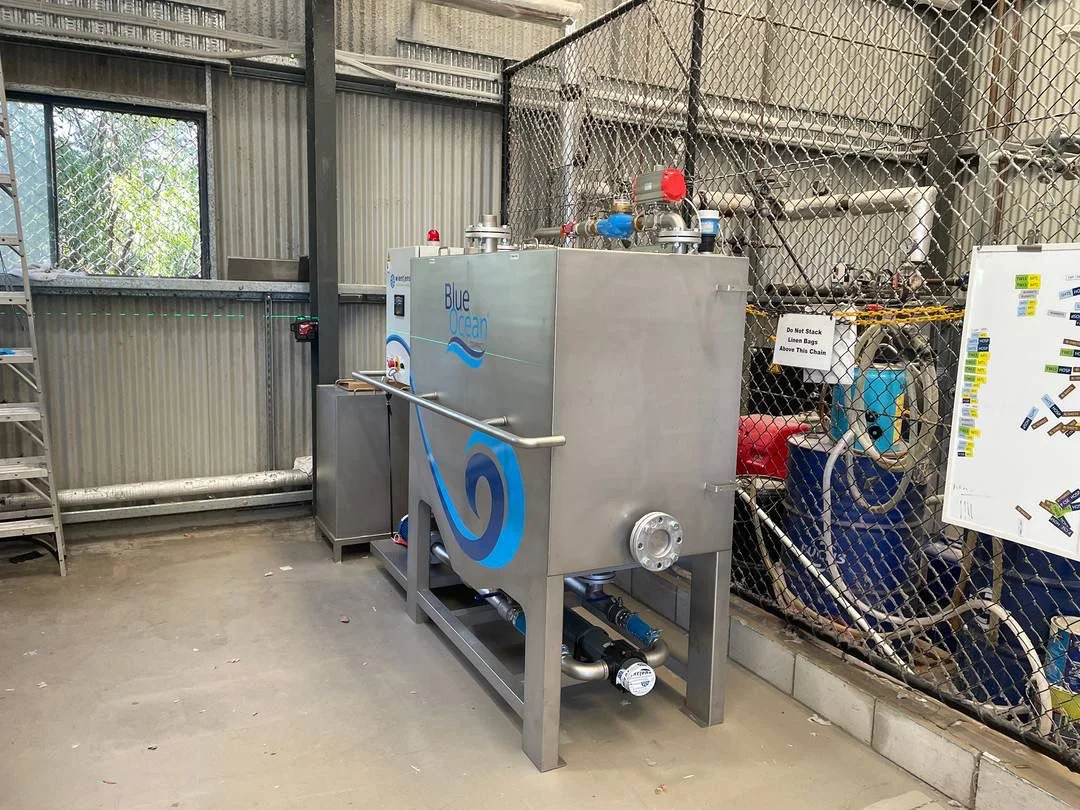
Our Wientjens water recycling systems use advanced 5-stage biological and membrane filtration to deliver clean, safe water for washing cycles.
Wientjens Blue Ocean Compact system
Wash cycle water exits tunnel washer or water extractors
Advanced disc filtration removes particles and contaminants
Thermal energy in the filtered water captured and reused
Filtered warm water returns to washing process at higher temperature
Continuous performance tracking and predictive maintenance alerts
We provide complete installation, maintenance, and support throughout the Singapore metropolitan area and surrounding Singapore regions.
Our Singapore-based installation and service team provides on-site support throughout the metro area.
Professional installation typically takes 5-10 business days from start to finish. Most Singapore facilities continue normal operations during installation, with work scheduled during off-peak hours to minimize disruption.
Our engineers visit your facility to assess water usage, available space, existing equipment, and utility connections. We then design a custom system optimized for your operations.
Equipment arrives on-site and is staged for installation. Our team prepares the installation area, including any required electrical or plumbing modifications.
Physical installation of tanks, filters, pumps, and control systems. Plumbing connections are made to washing machines and existing water supply. Electrical connections completed by certified electricians.
System startup, testing, and optimization. Your staff receives comprehensive training on operation, monitoring, and basic maintenance procedures.
Common questions from Singapore commercial laundries
Singapore commercial laundries achieve exceptional savings with Wientjens Blue Ocean water recycling due to Singapore having among the world's highest water costs driven by Water Conservation Tax. PUB (Public Utilities Board) charges (Singapore): Potable water: SGD$3.69/m³ (SGD$1.78 water price + SGD$0.60 waterborne fee + SGD$1.31 Water Conservation Tax at 60% for non-domestic). Trade effluent surcharge: SGD$1.56-$2.80/m³ depending on volume and strength. Combined water + wastewater costs: SGD$5.25-$6.49/m³ total (among highest globally). Water Conservation Tax increasing: Currently 60% for non-domestic, projected to increase to 70-80% by 2030 to encourage water conservation. Water recycling reduces consumption 45-65%, translating to exceptional annual savings by facility type: Hotels (200 rooms, 2000kg/day) - Save SGD$68K-SGD$133K/year on water alone. 150 rooms × 3 kg linen/day = 450kg laundry. 450kg × 7L/kg = 3,150L daily water use. 3,150L × 365 days = 1,149.75m³ annually. 50% water savings × 1,150 m³ × SGD$5.80/m³ (average) = SGD$3,335/year per room × 200 rooms = range of SGD$68K-SGD$133K based on 45-65% savings. Hospitals (200 beds, 3000kg/day) - Save SGD$101K-SGD$252K/year. Hospital linen 2.5kg/bed/day × 200 beds = 500kg. Additional ward linen and gowns = 2,500kg. Total 3,000kg × 7L/kg = 21,000L daily. 21m³ × 365 = 7,665m³ annually. 50% savings × 7,665 m³ × SGD$5.80/m³ = SGD$101K-SGD$252K annually. Commercial Laundries (100 tonnes/week) - Save SGD$160K-SGD$364K/year. 100,000kg ÷ 7 days = 14,286kg daily. 14,286kg × 7L/kg = 100m³ daily. 100m³ × 365 = 36,500m³ annually. 50% savings × 36,500 m³ × SGD$5.80/m³ = SGD$160K-SGD$364K annually. Additional savings: 12-15% energy savings from heat recovery (warm recycled water requires less heating - particularly valuable with Singapore's high electricity costs). Reduced trade effluent surcharges (45-65% reduction in discharge). Reduced chemical usage (cleaner recycled water). NEA compliance benefits and potential incentives. Typical ROI: 6-12 months for facilities processing 50+ tonnes/week (fastest internationally due to highest water costs globally). 12-18 months for smaller facilities (20-50 tonnes/week). Singapore has among fastest payback periods globally due to Water Conservation Tax.
Yes, water recycling works exceptionally well in Singapore's tropical climate and is actually critical given Singapore's extreme water scarcity as a water-stressed nation. System operation in Singapore conditions: Operates indoors in air-conditioned environments, unaffected by Singapore's tropical climate (hot, humid year-round, monsoon rainfall). System performance actually benefits from Singapore's warm ambient temperatures (enhances biological filter activity). Works continuously with 45-65% water savings regardless of season. Humidity has no negative impact on system performance. Singapore water scarcity context: Singapore is one of world's most water-stressed countries with no natural freshwater resources. Four National Taps strategy: Local catchment (17%), imported water from Malaysia (25%), NEWater (40%), desalination (18%). Malaysia water agreement expires 2061, creating long-term supply uncertainty. Singapore targets water self-sufficiency by 2060 through NEWater expansion and desalination. Water Conservation Tax implemented to discourage water wastage and fund water infrastructure. Historical water challenges in Singapore: 1961-1962 drought - Severe water rationing, highlighted vulnerability. 1997-1998 drought - Water imports from Malaysia at risk during political tensions. 2014 dry spell - Reservoir levels dropped, voluntary water conservation campaign. Ongoing - Climate change affecting rainfall patterns, increasing reliance on NEWater and desalination. Water recycling aligns with national water strategy: PUB actively encourages industrial water recycling as part of Singapore's water sustainability strategy. Commercial laundries with recycling demonstrate alignment with national water conservation goals. Reduces demand on Singapore's water supply infrastructure. Future-proofs operations against potential Malaysia water supply uncertainties. Contributes to Singapore's 2060 water self-sufficiency target. PUB strategy: PUB's Water Masterplan emphasizes industrial water efficiency and recycling. Target all high water-use industries to implement water recycling where feasible. Commercial laundries identified as priority sector for water efficiency (high-volume users with viable recycling technology). Water Conservation Tax expected to increase further (70-80% projected) to drive conservation behavior. NEWater expansion continues but industrial self-sufficiency encouraged. Singapore-specific water challenges: No natural water resources - Entirely dependent on Four National Taps. Malaysia supply uncertainty - Political tensions create supply vulnerability, 2061 agreement expiry looming. Climate change - Changing monsoon patterns affecting catchment yield. Limited land for reservoirs - Singapore's small size limits catchment expansion. High energy costs - Desalination and NEWater energy-intensive, driving water costs higher. Population density - High per-capita water demand in urban environment. NEA (National Environment Agency) compliance: NEA Environmental Protection and Management Act regulations apply to trade effluent discharge. Water recycling reduces discharge volumes, easing compliance with NEA discharge limits. Systems help facilities meet increasingly stringent environmental standards. NEA supports water recycling as part of Singapore's environmental sustainability framework.
Installation of Wientjens Blue Ocean water recycling systems in Singapore typically takes 5-7 days with minimal disruption to ongoing operations. Singapore-specific installation process: Week 1 - Pre-Installation Assessment (1-2 days): Free site visit across Singapore (Central, North, East, West, Jurong). Singapore-based installation team conducts detailed water audit and space assessment. Engineering team measures current water consumption from PUB bills, identifies optimal equipment location (considering Singapore's space constraints). Review existing laundry equipment (Primus, Miele, Electrolux, Jensen, Alliance compatibility). Site assessment covers: Current water usage from PUB bills (including Water Conservation Tax impact). Available floor space (systems fit in compact footprint suitable for Singapore facilities - 3m × 4m for Compact models). Existing plumbing and drainage capacity. Electrical supply adequacy (Singapore 230V 50Hz, 3-phase for larger systems). Building access for equipment delivery. HDB/BCA building requirements if applicable. Week 2-3 - Equipment Delivery & Preparation (3-5 days): Equipment ships from factory or regional distribution, clears Singapore customs, arrives at facility. Licensed Singapore plumbers and electricians prepare the site (PUB-licensed contractors). Plumbing modifications to redirect wastewater from washers to recycling system. Electrical connections installed by licensed EMA-registered electricians. Building modifications if needed (concrete pad, wall penetrations). Week 3-4 - System Installation (2-3 days): Wientjens Blue Ocean system installed and connected. Piping connections to laundry machines (tunnel washers, CBWs, batch washers). Control system integrated with existing equipment. System filled and initial testing performed. Week 4 - Commissioning & Training (1-2 days): System startup with full testing and optimization. Water quality verification to Singapore standards (SS245 Code of Practice for Water Supply, PUB requirements). Staff training on system operation, monitoring, basic troubleshooting. Cloud monitoring system activated for remote performance tracking (accessible from anywhere in Singapore). PUB & NEA compliance: PUB trade effluent discharge approval arranged by local partner (systems typically pre-approved as they reduce discharge volumes and improve quality). NEA Environmental Protection and Management Act compliance verification. Building consent coordination if required (BCA approval for building works). Singapore plumbing regulations (PUB Plumbing & Sanitary Works Regulations) compliance verified. Licensed plumber certification requirements met. Service areas: All Singapore regions serviced: Central - Orchard, Marina Bay, Bugis, Outram, Tanjong Pagar, Queenstown, Bukit Merah. North - Woodlands, Yishun, Sembawang, Ang Mo Kio, Bishan, Serangoon. East - Bedok, Tampines, Pasir Ris, Changi, Simei, Katong, Marine Parade. West - Jurong, Clementi, Bukit Batok, Choa Chu Kang, Boon Lay. Northeast - Hougang, Punggol, Sengkang. Sentosa - Resort facilities. Minimal operational disruption: Most Singapore facilities continue normal operations during installation (critical for 24/7 hotel operations). Work scheduled during off-peak hours or overnight if preferred. Phased installation minimizes downtime. Typical operational impact: 2-4 hours downtime for plumbing connections to washers.
Yes, Wientjens Blue Ocean water recycling systems are fully compliant with all PUB trade effluent regulations, NEA environmental requirements, and Singapore building standards. Regulatory compliance: PUB Trade Effluent Regulations - systems meet all discharge quality standards and reduce trade effluent volume by 45-65%, lowering trade effluent surcharges (SGD$1.56-$2.80/m³). NEA Environmental Protection and Management Act - recycling systems reduce environmental discharge and comply with all water pollution control standards. PUB Plumbing & Sanitary Works Regulations - all installations performed by PUB-licensed plumbers meeting Singapore plumbing standards. SS245 Code of Practice for Water Supply - recycled water meets Singapore water quality standards for non-potable reuse (recycled water used in pre-wash and main wash, potable water always used for final rinse). Singapore Building Code (Building Control Act) - all building modifications meet BCA requirements, consents arranged if needed. EMA (Energy Market Authority) - electrical installations by EMA-registered electricians meeting Singapore electrical safety standards. WSH (Workplace Safety and Health Act) - all installations meet workplace safety requirements. Water quality monitoring: Systems include continuous monitoring with cloud-based dashboards accessible from anywhere in Singapore. Water quality testing protocols ensure ongoing compliance with Singapore standards. Real-time alerts if water quality deviates from standards. pH, turbidity, temperature, and conductivity monitoring. PUB pre-approval process: PUB encourages industrial water recycling and has streamlined processes for compliant systems. Local partners handle all PUB trade effluent documentation and approvals. Trade effluent discharge permits amended to reflect reduced discharge volumes. Significant trade effluent surcharge reductions (typical 45-65% reduction in discharge). Insurance and liability: Systems include full liability insurance coverage for Singapore operations. Installation warranty covers all equipment and installation work. Ongoing maintenance plans ensure continued regulatory compliance. Public liability insurance covers any water quality issues (never occurred in 25+ year history). Industry certifications: Wientjens systems certified to international standards (CE, ISO 9001). Blue Ocean technology approved by water utilities across Australia, Europe, Asia, and Singapore. 1,500+ installations worldwide with zero regulatory compliance issues. Singapore Government support: Singapore Government's Green Plan 2030 encourages industrial water efficiency and recycling. Potential eligibility for NEA grants, PUB water efficiency incentives, or EDB sustainability grants. Recognition under PUB's Water Efficient Building (WEB) certification program. Singapore's 2060 water self-sufficiency target emphasizes industrial water recycling. Commercial laundries with recycling systems demonstrate commitment to national water sustainability goals. PUB values commercial partners who reduce potable water demand through recycling, especially given Water Conservation Tax policy objectives.
Any Singapore commercial laundry processing 2+ tonnes daily can benefit from water recycling, with excellent ROI given Singapore's exceptionally high water costs (among world's highest). Best suited for Singapore facilities: Hospitals & Healthcare - Public hospitals across Singapore. Private hospitals and medical centers. Aged care facilities across Singapore. Medical linen services. Hotels & Hospitality - Marina Bay hotels and resorts. Orchard Road hotels. Sentosa resorts. Airport hotels. Integrated resorts. Commercial Laundries - Industrial laundries in Jurong, Woodlands, Tuas, Tampines, Loyang. Hotel linen services across Singapore. Healthcare linen specialists. Hospitality linen services. Aged Care & Retirement - Aged care facilities across Singapore (government and private). Nursing home laundries. Respite care centers. Education & Institutional - University residential halls and campus accommodations. International boarding schools. Hospitality & Food Service - Restaurant and cafe linen services (particularly F&B establishments in hotels and integrated resorts). Catering company laundry operations. Cruise terminal operations. Sports & Recreation - Sports club laundries (country clubs, golf clubs, sports associations). Fitness center towel services across Singapore. Swimming pool and aquatic center facilities. Optimal facility profiles: Processing 2,000+ kg daily (20+ tonnes weekly) - ROI typically 6-12 months (among fastest globally). Processing 1,000-2,000 kg daily (10-20 tonnes weekly) - ROI typically 12-18 months. Processing 500-1,000 kg daily (5-10 tonnes weekly) - ROI typically 18-28 months. High-frequency washing operations (hotels with daily linen changes, hospitals with multiple daily loads). Facilities with high PUB water costs and Water Conservation Tax impact (SGD$5.25-$6.49/m³ combined). Businesses with sustainability reporting requirements (particularly MNCs and listed companies). Facilities seeking PUB Water Efficient Building certification or Green Mark certification. Singapore areas with highest concentration of suitable facilities: Central - Marina Bay (hotels, integrated resorts, commercial laundries serving CBD). Orchard (luxury hotels). East - Changi (airport hotels, healthcare facilities). Loyang, Tampines (industrial laundries). North - Woodlands, Yishun (industrial laundries, aged care). Sembawang (healthcare facilities). West - Jurong (industrial laundry hub, hospitals). Tuas (large-scale laundry operations). Boon Lay (commercial laundries). Not suitable for: Small operations processing less than 300kg daily (though even small Singapore operations may benefit given exceptionally high water costs). Heavily soiled industrial workwear requiring 100% potable water (though general workwear can use recycled water). Facilities washing heavily contaminated textiles exclusively. Facilities processing exclusively surgical or infection-control laundry (hospitals typically use recycling for general ward linen, patient gowns, sheets, towels - surgical linens use potable water).
Singapore has among the world's highest water costs, making water recycling exceptionally valuable with fastest ROI internationally. International comparison (2025 rates converted to SGD equivalent): Singapore (PUB) - Water: SGD$3.69/m³, Trade effluent: SGD$1.56-2.80/m³, Combined: SGD$5.25-$6.49/m³ (AMONG WORLD'S HIGHEST). Auckland, NZ - NZ$5.80/kL (SGD$5.22/m³ equivalent) - Comparable to Singapore. Sydney, Australia - AU$5.70/kL (SGD$5.13/m³ equivalent) - Slightly lower than Singapore. European capitals - Typically EUR€3-5/m³ (SGD$4.50-$7.50/m³ equivalent) - Variable. Bangkok, Thailand - ฿25/m³ (SGD$0.92/m³ equivalent) - 83% cheaper than Singapore. Kuala Lumpur, Malaysia - MYR$1.38/m³ (SGD$0.42/m³ equivalent) - 93% cheaper than Singapore. Singapore-specific cost drivers: Water Conservation Tax 60% for non-domestic (increasing to 70-80% projected by 2030). No natural water sources - 100% reliant on Four National Taps (catchment, Malaysia imports, NEWater, desalination). High desalination costs (50% of supply from energy-intensive desalination by 2060). NEWater expansion costs (advanced membrane technology). Malaysia water supply costs (political risk premium). Climate change adaptation (more variable rainfall patterns). Water price projections for Singapore: PUB projects 2-4% annual water price increases for next decade. Water Conservation Tax increases likely (currently 60%, projected 70-80% by 2030 to meet 2060 self-sufficiency target). Combined rates projected to reach SGD$6.50-$7.50/m³ by 2030. Singapore laundry cost comparison (SGD): Small laundry (20 tonnes/week, 2,600 m³/year): Singapore: SGD$15,080/year water costs (HIGHEST REGIONALLY). Bangkok: SGD$2,392/year (84% cheaper than Singapore). Medium laundry (50 tonnes/week, 6,500 m³/year): Singapore: SGD$37,700/year water costs (HIGHEST REGIONALLY). Bangkok: SGD$5,980/year (84% cheaper). Large laundry (100 tonnes/week, 13,000 m³/year): Singapore: SGD$75,400/year water costs (HIGHEST REGIONALLY). Bangkok: SGD$11,960/year (84% cheaper). ROI comparison: Singapore - FASTEST ROI globally (6-12 months) due to world's highest water costs with Water Conservation Tax. Auckland - Fast ROI (6-12 months) with similar costs. Sydney/Melbourne/Adelaide - Fast ROI (6-16 months) with high Australian water costs. Bangkok/Chiang Mai - Slower ROI (18-30 months) due to much lower water costs. Singapore's exceptional value proposition: Singapore laundries with water recycling save SGD$2.36-$4.22/m³ (45-65% of SGD$5.25-$6.49/m³). This creates largest absolute cost savings internationally given highest baseline costs. As Singapore Water Conservation Tax increases toward 70-80%, savings will grow proportionally. Singapore's 2060 water self-sufficiency strategy ensures continued high water pricing to discourage wastage. Commercial laundries with recycling gain competitive cost advantage and demonstrate national water sustainability commitment. Singapore Government benefits: PUB Water Efficient Building (WEB) certification potential (Gold/GoldPLUS ratings). Singapore Green Plan 2030 alignment (resource resilience pillar). Potential eligibility for NEA Energy Efficiency Fund or PUB water efficiency grants. Enhanced corporate sustainability reporting (particularly important for MNCs, REITs, listed companies). Major integrated resorts and hotel groups increasingly require supplier water efficiency. Conclusion: Singapore's position as one of world's most water-scarce nations with highest water costs means water recycling delivers fastest ROI globally, typically 6-12 months for facilities processing 50+ tonnes weekly. With Water Conservation Tax projected to increase from 60% to 70-80% by 2030, and Singapore's 2060 water self-sufficiency target driving continued price increases, water recycling represents both immediate cost savings and strategic long-term value for Singapore commercial laundries.
Powered by Wientjens 🇳🇱
DUTCH ENGINEERING EXCELLENCE
Official Blue Ocean technology partner for Australia, New Zealand, Singapore, Thailand & Southeast Asia. Trusted by commercial laundries worldwide for proven water and energy recycling solutions.